09/24/26
By Rich Guida
A simple look at why "#2 diesel" is not always the same fuel from stop-to-stop.
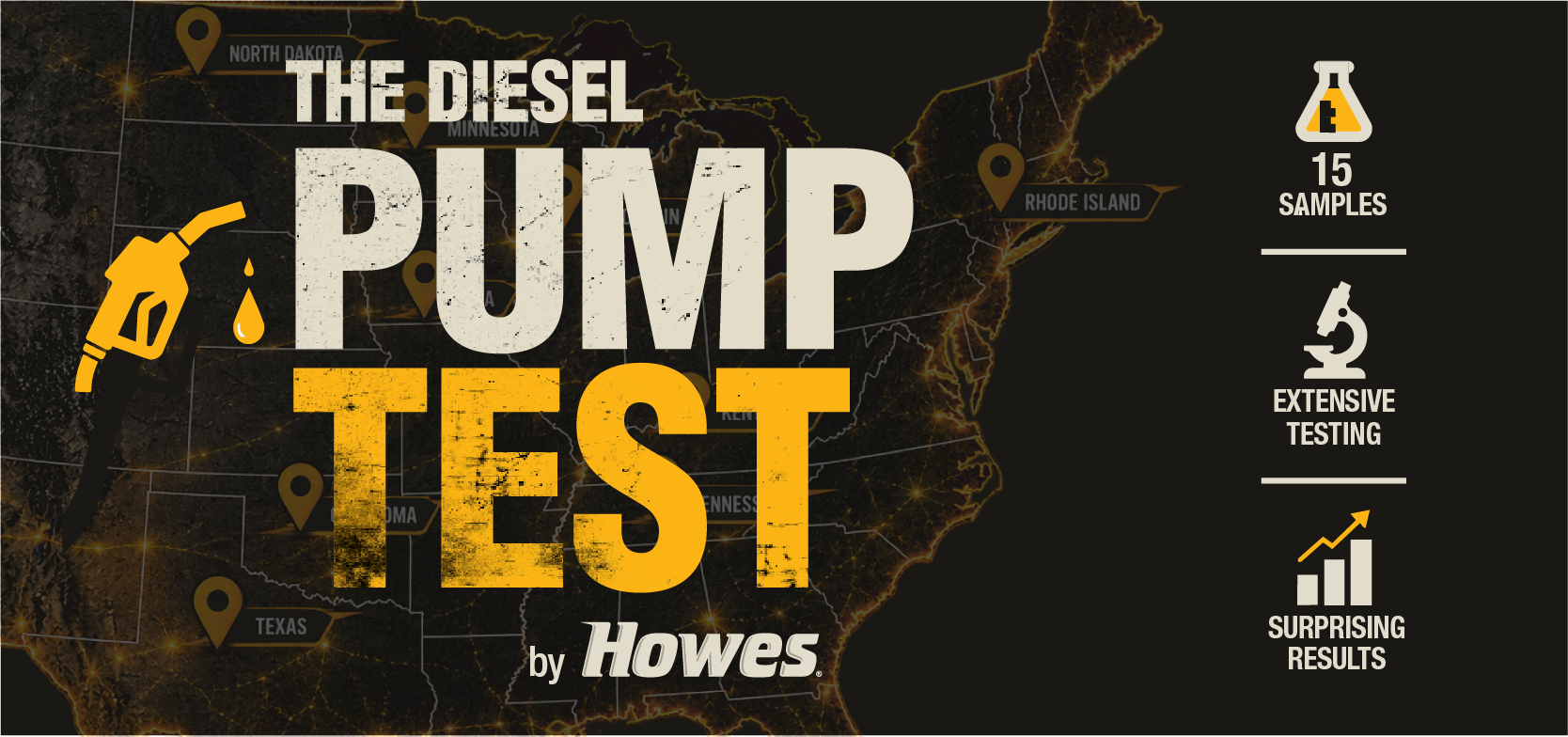
We often hear pump diesel discussed as if it were one standard product. This study showed that it is not. Fifteen winterized #2 diesel samples were collected from real pump dispensers across the United States and tested as received. To ensure the samples reflected real-world conditions, the fuel was gathered by a group of Howes customers, partners, and industry influencers including:
Using these partners to gather the samples highlights the randomness and impartiality of the process, resulting in a truly independent and original collection of diesel fuel samples.
BOTTOM LINE: Samples were collected at various locations in Wisconsin, Tennessee, Kentucky, North Dakota, Minnesota, Texas, Oklahoma, Iowa, Nevada, Rhode Island, and Canada.
The 15 samples were not uniform. Wide differences were measured in cold-flow behavior, flash point, biodiesel content, water, and lubricity.
The samples were checked for six properties that matter in the real world: Cloud Point, Cold Filter Plugging Point (CFPP), Flash Point, biodiesel content, water content, and High Frequency Reciprocating Rig (HFRR) lubricity.
That is a wide spread. Those ranges show that the fuel sold as pump diesel can differ in more than one way at the same time.
All samples were a "winter blend", and some samples were winterized with about 20%-30% #1 ULSD. That matters because #1 diesel usually has less wax than #2 diesel, which allows it to remain usable at colder temperatures. That helps explain why some samples had much colder Cloud Point and CFPP values than others.
In plain language, the coldest samples were probably not just "better diesel." They were likely different blends. That means two fuels sold under the same basic pump label can behave very differently in cold weather.
Even after the #1-cut samples were set aside as winterized outliers, the remaining samples still did not show one uniform fuel type. Samples with similar cold-flow numbers still showed clear differences in flash point, water content, biodiesel level, and lubricity.
One of the clearest examples came from samples collected in the northern areas. Both had a Cloud Point of -19 °C, and their Flash Points were almost identical: 135.2 °F and 135.7 °F. At first glance, those two fuels looked very similar.
But their HFRR results were far apart: 476 µm for one sample versus 252 µm for the other.
That is important because HFRR is a wear test. A smaller wear scar indicates better lubricity. So, these two fuels looked similar in quick screening tests, but they did not provide the same wear protection.
This highlights an important point: cold-flow numbers and flash point do not reliably predict lubricity. Two fuels can look similar on paper and still act very differently inside a fuel system.
The study also showed meaningful variation within the samples collected by the same driver. This means the differences were not only regional, but they also appeared during normal day-to-day refueling.
That pattern matters. A driver can stop at different pumps during the same general work period and still encounter fuels with very different wear performance.
Water was tracked because it can contribute to corrosion, icing, storage problems, and filter loading. However, in this dataset, water levels did not align with the worst lubricity result.
The worst HFRR result was 476 µm, and that sample had 21.0 ppm water. The highest water result in the study was 56.2 ppm, but that sample had an HFRR of 262 µm, which was much better than the worst case.
So while water still matters, it was not the primary driver of the largest HFRR variation in this sample set. The larger wear differences were more likely tied to broader fuel-to-fuel chemistry differences.
There is not one single "good" or "bad" water number for diesel, because the amount of water the fuel can hold changes with temperature and fuel composition. Straight #1 ULSD is often described as holding only about 50 ppm of dissolved water, and a commonly cited industry range is about 60 to 100 ppm before water starts to fall out of #2 diesel and become free water.
In practical terms, water in the 10-20 ppm range are usually not alarming for an as-received pump sample, while values climbing into the 40 to 60+ ppm range are better viewed as a watch item than an automatic failure.
The real red flag is free water or haze, because once water drops out of solution it becomes much more likely to contribute to corrosion, icing, and filter problems.
By that standard, the 13.2 to 56.2 ppm water results in this study fit better into the category of low-to-moderate water levels that deserve attention, rather than severe water contamination by themselves.
Biodiesel was measured in all 15 samples. Ranging from 0.2% to 6.1% by volume. One sample was above 5%. This means low-level biodiesel was part of the real-world pump fuel picture in this group, even when it may not have been obvious to the person purchasing the fuel.
Low-level biodiesel can improve lubricity, but it can also increase the need for water control, microbial control, and filter maintenance. In other words, biodiesel can help in one way while still creating storage and maintenance concerns in another.
The data does not support the idea that pump diesel is one uniform product. In this 15-sample set, the fuel changed in measurable ways from stop-to-stop. Some of the cold-flow spread was explained by winterization with #1 ULSD, but winterization did not explain everything. Differences in lubricity, flash point, water, and biodiesel level remained very significant.
The simplest way to say it is this: the label at the pump may stay the same, but the fuel behind that label can still be very different.