06/10/26
By Rich Guida
Most diesel owners think about fuel additives when the weather gets cold. Winter fuel problems are obvious: fuel can gel, filters can plug, and engines can struggle to start.
But warm weather creates its own diesel fuel problems. They are usually quieter and build gradually. By the time you notice them, they may already be costing you fuel economy, throttle response, engine performance, and long-term fuel system protection.
Hot weather, long-haul driving, heavy towing, agricultural work, extended idle time, and increased equipment usage all place extra demand on a diesel fuel system. During the summer, your engine may be running longer, working harder, and burning more fuel than it does during any other season.
That raises an important question: do diesel engines need fuel additives in the summer?
For many diesel pickups, heavy-duty trucks, tractors, RVs, construction machines, and other diesel-powered equipment, the answer is yes. A quality warm-weather diesel additive can help protect against the hidden fuel system problems that cause excessive DPF regens and reduce performance over time, including fuel contamination, injector deposits, water, poor lubricity, and accelerated wear.
Unlike cold-weather fuel problems that can stop an engine in its tracks, summer fuel problems tend to build quietly over time. A diesel engine may seem to run normally at first, even while water, contamination, and injector deposits are slowly starting to affect what is happening inside the fuel system.
Modern diesel engines rely on an incredible level of precision. The injectors are not simply pouring fuel into the engine, they are spraying it in a finely controlled pattern so it can atomize properly and burn as cleanly and efficiently as possible. When deposits begin to form on those injectors, even small disruptions in that spray pattern can affect combustion. Over time, that can show up as weaker throttle response, reduced fuel economy, more smoke, rougher operation, or an engine that has to work harder than it should to produce the same power.
That is why summer diesel fuel maintenance is really about prevention. In a modern diesel fuel system, an ounce of prevention is worth a pound of cure, because keeping fuel clean, injectors protected, and critical components properly lubricated is much easier than trying to recover lost performance, poor fuel economy, or premature wear after the problem has already started.

Summer often means diesel engines are not only running in hotter weather, but also working harder and running longer than they do during other parts of the year. A pickup may spend the weekend towing a camper, boat, or equipment trailer. A semi may be covering long-haul routes through high temperatures. Farm equipment may be running long days during peak seasonal use, while construction equipment idles for hours on hot jobsites. Even RVs may sit for stretches between trips, then run long distances under load.
Those conditions all place extra demand on the fuel system. More operating hours mean more fuel moving through the system, while heavy loads require clean, consistent combustion to maintain power and efficiency. Extended idle time can contribute to soot, buildup, and inefficient operation, and agricultural or jobsite equipment may be exposed to fuel storage conditions where water, dirt, rust, or microbial contamination are more likely.
In other words, summer is not just warmer weather. For many diesel engines, it is peak-use season, and that makes fuel system protection especially important.

Diesel fuel does more than simply power the engine. Before it ever burns, it has to travel through some of the most precise and expensive parts of the entire fuel system, including high-pressure pumps, injectors, fuel lines, filters, and other critical components. In modern diesel engines, those parts are built to work within extremely tight tolerances, which means fuel quality has a direct impact on how well the system performs and how well it holds up over time.
Water is one of the most common problems diesel owners have to watch for, and it can be especially frustrating because it does not always come from an obvious source. It can get into diesel fuel through condensation, storage tanks, transfer tanks, contaminated fuel sources, or poor handling practices. For equipment that uses bulk fuel storage, sits for long periods between uses, or operates in humid summer conditions, water contamination can become an even bigger concern.
Once water gets into the fuel system, it can create several problems. It may contribute to corrosion, interfere with combustion, lead to fuel filter issues, and create conditions where microbial growth becomes more likely. It can also disrupt the clean, consistent burn your engine needs to maintain reliable power and fuel economy.
This is one reason a good summer diesel additive should do more than simply clean injectors. Injector cleanliness matters, but fuel system protection is bigger than that. A well-rounded additive should also help manage water in the fuel, support clean combustion, and protect the components that fuel touches on its way through the system.
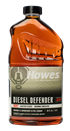
Howes Diesel Defender is designed to safely remove water by demulsifying it, which helps separate water from the fuel so cleaner fuel is left to burn. It is also alcohol-free and petroleum-based, making it a strong choice for regular fuel system protection during warm-weather use.
Fuel contamination is not limited to water. It can also include dirt, rust, and other fine particles that make their way into the fuel through older storage tanks, transfer tanks, farm tanks, jobsite fueling systems, or everyday fuel handling. This is especially relevant for equipment that is fueled away from standard retail pumps or relies on stored diesel for extended periods of time.
Fuel filters are designed to catch contaminants, but dirty fuel still makes the system work harder than it should. Over time, repeated exposure to contaminated fuel can increase filter maintenance, reduce system efficiency, and contribute to unnecessary wear on critical components.
That matters because modern diesel systems are not forgiving. Injectors and fuel pumps operate under demanding conditions, and they rely on clean, consistent, properly treated fuel to perform the way they were designed to. Even small contaminants can become a bigger issue when an engine is working long hours, towing heavy loads, idling in hot weather, or running through peak seasonal use.
The cleaner and more consistent the fuel, the better chance the engine has to maintain strong performance, reliable combustion, and long-term fuel system health.
Injector deposits are one of the most important hidden issues inside a diesel fuel system because they can affect performance long before they become obvious to the driver. Diesel injectors are responsible for delivering fuel in a precise spray pattern, and that pattern matters. The fuel needs to atomize properly so it can mix with air and burn as efficiently as possible.
When deposits begin to form on or inside the injectors, that precision can start to suffer. The fuel may not spray as evenly or atomize as cleanly, which can affect combustion quality. Over time, that can show up as weaker throttle response, reduced power, lower fuel economy, rougher idle, more smoke, or higher emissions.
The difficult part is that injector deposits usually do not cause a dramatic change overnight. They tend to build gradually, which means the engine may feel normal until enough performance has been lost that the difference becomes noticeable. A diesel may still start, run, tow, and idle, but it may not be doing any of those things as efficiently as it should.
A high-quality diesel injector cleaner can help remove deposits and prevent new ones from forming, which is one of the main reasons Diesel Defender makes sense as a regular-use summer additive. It uses Howes’ advanced IDX4® Detergent to clean fuel injectors and help prevent future deposits, including Internal Diesel Injector Deposits (IDID’s). For engines that are working hard in warm weather, that kind of ongoing injector protection makes a meaningful difference.
Modern Ultra Low Sulfur Diesel (ULSD) fuel does not always provide the same lubricating protection that older diesel fuel once did. That matters because diesel fuel is not only burned for power, it also passes through components that depend on proper lubrication, including fuel pumps, injectors, and upper cylinders.
When lubricity is low, friction and wear can increase. That may not cause an immediate failure, but over time, additional friction inside a high-pressure fuel system can shorten the life of expensive components. Fuel pumps and injectors are not parts most owners want to replace early, especially when the wear may have been preventable with better fuel treatment and maintenance habits.
This is where prevention really matters. Protecting a fuel system before wear becomes a problem is far easier than trying to deal with damaged components after the fact. Diesel Defender adds maximum lubricity to help protect injectors, pumps, and upper cylinders, which makes it especially valuable for diesel engines that work hard during the summer.
For trucks, tractors, RVs, heavy-duty equipment, and long-haul vehicles, added lubricity is not just a nice extra. It is part of keeping the fuel system protected through long hours, heavy loads, hot temperatures, and repeated use.
Fuel economy is one of the first places dirty fuel and injector deposits can quietly cost you. The frustrating part is that the loss is often gradual enough that it may not be obvious from one tank to the next. Instead, fuel mileage may slowly slip over time as injectors get dirtier, combustion becomes less efficient, and the engine has to work harder to produce the same amount of power.
Clean injectors help maintain a steady, properly atomized spray pattern, which supports more complete and efficient combustion. When injectors are dirty, fuel may not atomize as well, and the engine may not burn that fuel as cleanly or efficiently. That can lead to wasted fuel, reduced throttle response, and lower MPG.
Contaminated fuel can make the problem worse. Water, particles, and inconsistent fuel quality can contribute to inefficient combustion, filter issues, reduced performance, and added stress on the system. Over a summer of towing, hauling, idling, long-distance driving, or agricultural work, even small efficiency losses can add up.
Of course, a diesel additive cannot fix every cause of poor fuel economy. Tire pressure, driving speed, load weight, maintenance, air filters, emissions systems, and engine condition all matter too. But fuel quality and injector cleanliness are a major part of the equation, which is why treating fuel consistently makes sense during peak-use months.
Performance is another major reason to pay attention to summer diesel fuel treatment. When injectors are dirty or fuel quality is inconsistent, the engine may not respond as cleanly or as confidently as it should. This can be especially noticeable when the engine is under load, such as when towing, hauling, climbing grades, working in the field, or running long hours in hot weather.
Dirty injectors can affect how fuel is delivered and burned, which can lead to symptoms like sluggish throttle response, rough idle, more smoke than normal, reduced power under load, lower MPG, harder starts, more frequent fuel filter issues, or more frequent DPF regens if poor combustion is contributing to excess soot.
These symptoms can have more than one cause, so it is important not to assume every performance issue can be solved with an additive. A clogged fuel filter, air restriction, boost leak, sensor issue, DPF problem, or mechanical failure can also affect performance. But clean fuel and clean injectors are foundational. If the engine cannot receive, spray, and burn fuel properly, performance is going to suffer.
For diesel engines that are towing, hauling, idling, or working through hot summer conditions, keeping injectors clean helps support better atomization, more complete combustion, smoother operation, and stronger throttle response. That is why a well-rounded summer diesel additive can be such a practical part of regular maintenance.
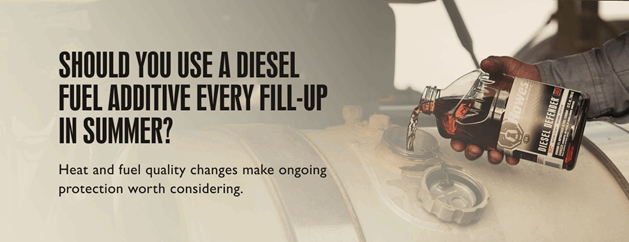
If your diesel engine is working hard in the summer, using a quality diesel fuel additive at every fill-up is a smart habit. You do not have to wait until your truck loses power, your fuel economy drops, or your injectors are already dirty before you start taking fuel system protection seriously.
Regular treatment helps address the kinds of problems that build gradually inside the fuel system. Treating every fill-up can help keep injectors cleaner, support better fuel atomization, maintain throttle response, improve fuel economy, add lubricity for pumps and injectors, help remove water from fuel, reduce deposit formation, support more complete combustion, and protect against long-term fuel system wear.
That consistency matters because summer often means more miles, more operating hours, more towing, more idling, and more demand on the fuel system. A one-time treatment may help in certain situations, but using an additive regularly gives the system ongoing support before performance problems have a chance to build.
For regular summer use, Diesel Defender is a strong all-around choice because it is not just an injector cleaner. It combines injector cleaning, deposit prevention, added lubricity, water removal, fuel economy support, emissions reduction, and performance benefits in one product. That makes it a practical treat-every-fill-up additive for diesel owners who want a simple way to help protect their fuel system through warm-weather use.
Howes Diesel Defender is built for the hidden diesel fuel system problems that become especially important during warm-weather use. It is designed to clean fuel injectors, help prevent future deposits, add maximum lubricity, safely remove water, support fuel economy, reduce exhaust emissions, and boost engine performance and power.
That makes it a practical choice for diesel pickups, heavy-duty trucks, RVs, tractors, farm equipment, construction equipment, long-haul trucks, and recreational towing vehicles. Whether the engine is pulling a trailer, running through long workdays, idling on a hot jobsite, or covering miles on the highway, consistent fuel treatment can help support cleaner, more reliable performance.
As a summer fuel additive, Diesel Defender is best used as an everyday preventative treatment. Adding it at every fill-up helps keep protection consistent, rather than waiting until performance problems appear. That is especially important because many fuel system issues are already underway before the driver notices a major change.
Diesel Defender can also be used as a cleanup treatment when needed. If fuel economy has dropped, throttle response feels sluggish, injectors may be dirty, or the engine has been exposed to questionable fuel, Diesel Defender can help clean the fuel system and support restored performance when used as directed.
The best approach is simple: treat regularly before problems show up.
A diesel fuel additive is important, but it should be part of a broader fuel system maintenance routine. Summer is often the peak-use season, so it is a good time to make sure the basics are covered before long trips, heavy towing, harvest, construction work, or extended equipment use.
Replace fuel filters on schedule, and drain the fuel/water separator if your engine is equipped with one. Buy fuel from reputable sources whenever possible, and be especially careful with stored fuel, transfer tanks, bulk tanks, and equipment that sits for long periods between uses. Keeping tanks clean and maintained can go a long way toward reducing exposure to water, dirt, rust, and microbial contamination.
It also helps to pay attention to how the engine is behaving over time. Track fuel economy, watch for water-in-fuel warnings, and do not ignore changes like rough idle, more smoke than normal, sluggish throttle response, reduced power, or harder starts. Small performance changes can be early signs that the fuel system needs attention.
Finally, treat fuel consistently with a warm-weather diesel additive like Diesel Defender. Used as part of a regular maintenance routine, it helps protect against the hidden fuel system problems that are easy to overlook until they start affecting performance, fuel economy, or reliability.
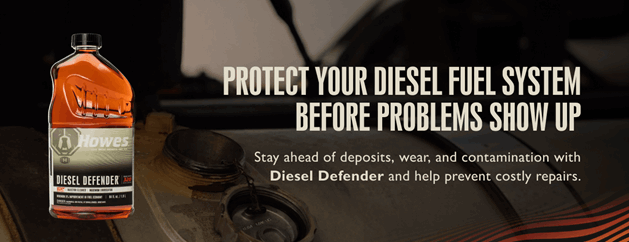
So, do diesel engines need fuel additives in summer?
For hard-working diesel engines, the answer is yes. Summer fuel problems may not be as obvious as cold-weather fuel problems, but they can still affect fuel economy, engine performance, injector cleanliness, and long-term fuel system wear.
Hot weather, heavy use, long-haul driving, agricultural work, towing, and extended idle time all create conditions where clean fuel and strong fuel system protection matter. Modern diesel engines rely on precise fuel delivery, clean injector spray patterns, proper lubrication, and consistent combustion. When any of those begin to suffer, the engine may still run, but it may not run as efficiently or as powerfully as it should.
A high-quality diesel fuel additive helps protect against the hidden problems inside the modern diesel fuel system. For warm-weather protection, Howes Diesel Defender is the best well-rounded option available.
Diesel Defender helps:
Used at every fill-up, Diesel Defender makes fuel treatment simple. It gives hard-working diesel engines consistent support through the heat, long hours, heavy loads, and demanding conditions of summer.
Yes, diesel engines benefit from fuel additives in summer. Warm weather, heavy use, towing, idling, and long operating hours can all contribute to fuel contamination, injector deposits, water issues, reduced fuel economy, and fuel system wear. A good summer diesel additive helps protect against those problems before they become more noticeable.
A good summer diesel additive should do more than one thing. It should clean injectors, help prevent deposits, add lubricity, remove water, support fuel economy, and protect the fuel system. Howes Diesel Defender is designed to provide all of these benefits in one warm-weather diesel fuel additive.
For the best preventative protection, using a diesel additive at every fill-up is a smart routine. Consistent treatment helps keep injectors clean, supports fuel economy, adds lubricity, helps manage water, and reduces the chance that hidden fuel system problems will build over time.
Yes. Dirty injectors can disrupt the fuel spray pattern, which may reduce combustion efficiency. When fuel does not atomize and burn as cleanly as it should, the engine may use more fuel to produce the same power. Over time, that can lead to lower MPG, reduced throttle response, rougher operation, and lost performance.
A diesel additive is not a repair for a DPF problem. However, clean injectors and more complete combustion can help reduce excess soot when poor fuel quality or dirty injectors are contributing factors. By supporting cleaner combustion, a product like Diesel Defender can help reduce unnecessary DPF regeneration frequency as part of a properly maintained system.
Yes, a quality diesel fuel additive can help protect injectors and fuel pumps by adding lubricity, removing water, and helping prevent harmful deposits. Diesel Defender is specifically designed to provide lubricity for injectors, pumps, and upper cylinders while also cleaning and protecting the fuel system.