07/16/26
By Rich Guida
Most diesel owners know their engine has a turbocharger. Few understand what it actually does, how it does it, or why a diesel depends on it.
Turbochargers are not performance upgrades bolted onto an otherwise complete engine. They are essential components that make modern diesel engines efficient, powerful, and capable of meeting today's emissions standards. A diesel without a properly functioning turbo is not just slower, it’s a fundamentally compromised machine.
Understanding how a turbocharger works helps you recognize early warning signs, make better maintenance decisions, and understand why certain problems develop the way they do.
This article walks through the complete turbo cycle, explains why diesel engines rely on forced induction in a way that gasoline engines simply do not, and covers practical maintenance steps to keep your turbo spinning the way it should. Proper turbo care, combined with quality diesel fuel additives that protect injector health, goes a long way toward maintaining diesel engine performance and fuel economy over the long haul.
The core job of a turbocharger is straightforward: it compresses air before it enters the engine's cylinders. That compression packs oxygen molecules closer together, creating denser air that carries more oxygen in the same volume. More oxygen in the combustion chamber means you can inject more fuel while still maintaining proper combustion. The result is more mechanical power and a more efficient burn overall.
That one function has a significant downstream effect.
Turbochargers allow manufacturers to reduce engine size without sacrificing power. Smaller turbocharged diesel engines offer better packaging, less weight, and improved fuel economy compared to larger naturally aspirated engines producing similar output. The turbocharger is why modern diesel trucks can pull serious weight from engines that would look undersized sitting on a workbench.
A turbocharger has two distinct sides connected by a single shaft.
The turbine side consists of a turbine wheel and turbine housing. Exhaust gas flows out of the engine and into the turbine housing, which channels it directly onto the turbine wheel. The energy in those hot exhaust gases spins the wheel, and the spent gas exits through the outlet area.
On the other end, the compressor side has its own wheel and housing. A forged steel shaft connects the compressor wheel directly to the turbine wheel. When the turbine spins, it drives the compressor wheel at the same speed. That spinning compressor wheel draws in fresh air and compresses it.
The compressor housing then performs a process called diffusion. High-velocity, low-pressure air coming off the spinning wheel gets converted into high-pressure, low-velocity compressed air. That pressurized air gets pushed into the engine, where it enables more fuel to burn and more power to be made.
The turbocharger produces no power of its own. It creates the conditions that allow the engine to make more power itself.
Diesel engines compress air first, then inject fuel. That is a fundamentally different process from a gasoline engine, and it makes turbochargers especially critical for diesel performance and efficiency.
Diesels also handle lean air-fuel ratios without the problems that would plague a gas engine. Torque output is controlled by how much fuel gets injected into the combustion chamber, not by the ratio of the air-fuel mixture itself. When the turbocharger supplies more air than the current fuel injection demands, the engine simply uses what it needs and adjusts accordingly.
There is another important advantage to turbochargers on diesel engines. Adding more compressed air effectively raises cylinder pressure. In a gasoline engine, that creates pre-ignition where fuel and air are both present during compression, so the mixture can ignite before the spark plug fires. Diesels do not have this problem because fuel is not in the cylinder during the compression stroke. It enters only when the piston approaches top dead center. No fuel present during compression means pre-ignition cannot happen, which is why diesel engines can safely run higher boost pressures than their gasoline counterparts.
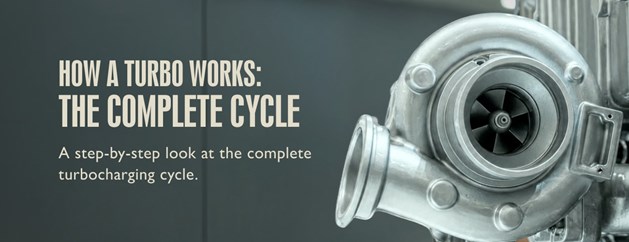
Understanding the individual components of a turbocharger is one thing, but seeing how they work together is where it gets interesting.
It starts with ambient air moving through your air filter and into the compressor housing. The compressor wheel, spinning at extreme speed, draws that air inward and flings it outward through centrifugal force. As it does, pressure builds. The compressor housing converts that high-velocity, low-pressure airflow into compressed, high-pressure air ready to enter the engine.
That compressed air is the foundation of everything the turbo does.
Compression creates heat. Discharge temperatures can climb past 400°F by the time air exits the compressor. Hot air expands and loses density, which means less oxygen per volume, and exactly the opposite of what you want.
This problem gets solved with the intercooler. It cools the compressed air before it reaches the intake manifold, making the air more dense. Denser air carries more oxygen molecules into the cylinder with every charge. That extra oxygen is what lets the engine burn more fuel and make more power.
The dense, cooled air enters the combustion chamber on the intake stroke. The piston then compresses that air to extreme pressure, generating approximately 1,400 degrees Fahrenheit of heat in the process.
Fuel injection happens precisely as the piston approaches top dead center. The fuel hits that superheated compressed air and ignites spontaneously, with no spark plug required. That is compression ignition.
After combustion, hot exhaust gases exit the chamber and flow directly into the turbine housing. Those gases strike the turbine wheel blades, releasing their thermal and kinetic energy in the process. This makes the turbine wheel spin, with speeds approaching 150,000 RPM.
The turbine and compressor wheels share a forged steel shaft supported by a bearing system in the center housing. Whatever speed the turbine reaches, the compressor matches it exactly.
That connection is what makes the whole system self-sustaining.
Exhaust gases spin the turbine. The turbine spins the compressor. The compressor pushes more air into the engine. More air means more fuel burned, more power produced, and more exhaust energy generated, which spins the turbine faster, which builds more boost.
The cycle feeds itself as long as the engine runs.
That is not magic. That is the turbocharger doing exactly what it was designed to do, extracting energy from exhaust gases that would otherwise go straight out the tailpipe and putting that energy back to work inside the engine.
Now that the cycle makes sense, it's worth understanding what that cycle actually delivers. The turbocharger is not just moving air. It is doing several things simultaneously that define how a diesel engine performs, how efficiently it burns fuel, and how cleanly it operates.
Cylinder pressure determines torque output, a direct and mechanical relationship.
Higher boost pressure allows diesel engines to generate increased brake mean effective pressure (BMEP), which is what actually produces torque at the crankshaft. Turbocharged diesels deliver peak torque at very low RPM, often below 2,000, and hold those values up through around 3,500 RPM. That flat, accessible torque curve is what makes a turbocharged diesel so capable for towing, hauling, and working under load.
Gasoline engines cannot match that level of torque at low RPM. Because diesels have no spark plugs and inject fuel only near top dead center, there is no risk of pre-ignition during the compression stroke. That allows the turbocharger to operate at higher, more stable boost pressures, which produces fuller torque curves at lower engine speeds.
Turbochargers let manufacturers build smaller engines that produce the same power as larger naturally aspirated ones. That downsizing matters for fuel economy and emissions requirements.
Turbocharged diesel engines can improve fuel efficiency by as much as 40 percent compared to their naturally aspirated equivalents producing similar output. The reason is straightforward: the turbocharger recycles exhaust energy that would otherwise exit through the tailpipe as wasted heat. Instead of throwing that energy away, the system puts it to work compressing intake air and enabling more efficient combustion.
Complete combustion produces carbon dioxide and water. Incomplete combustion produces particulates, unburned hydrocarbons, and toxins.
The turbocharger pushes the combustion process toward the complete side of that equation. More air means more oxygen available to fully burn the fuel being injected. Higher boost pressure also enables increased exhaust gas recirculation (EGR) rates without sacrificing power output, which helps reduce nitrogen oxide emissions.
That combination of cleaner combustion and lower NOx is part of why modern turbocharged diesels can meet emissions standards that would be impossible for a naturally aspirated diesel to achieve.
A naturally aspirated diesel depends entirely on atmospheric pressure to fill its cylinders on each intake stroke. Because the engine gets exactly what the atmosphere delivers, that ceiling limits power density. The turbocharger removes it.
By forcefully pushing more air into the cylinder, the turbo allows more fuel to ignite in the same combustion volume. Power output in a diesel depends directly on air mass available for combustion. The turbocharger is what makes that air mass variable, and therefore what makes modern diesel power levels possible.
Now that you understand how the turbocharger on your diesel works, the next step is to make sure it’s maintained properly.
Turbos do not fail randomly. They fail because of neglected oil, ignored leaks, skipped cooldown periods, and warning signs that got dismissed too long. Most premature turbo failures are preventable.
Here’s what actually matters.
Boost leaks are quiet killers. Even small leaks of 1-3 psi cause real damage, sluggish low-end performance, slower turbo spool, and exhaust gas temperatures that climb higher than they should.
Testing for them is straightforward. Connect a boost leak detector to your turbo inlet and pressurize the system to 10-20 psi using a standard compressor. The pressure needle should hold for about 45 seconds before dropping to zero. Then spray soapy water on boots, intercooler connections, and intake manifold gaskets and look for bubbles, which show you exactly where air is escaping.
Fuel quality has a direct and significant impact on how hard your turbo has to work.
Dirty diesel injectors cause poor combustion which puts more unburned carbon into the exhaust stream. That carbon flows directly through the turbine side of your turbocharger, and over time, creates build-up that degrades performance.
Higher-quality fuel improves injector reliability, limits corrosion from water intrusion, and supports better diesel fuel economy across the entire fuel system. A quality diesel fuel additive like Howes Diesel Defender addresses this at the source. Diesel Defender helps clean stubborn diesel injector deposits with its proprietary IDX4® Detergent and adds lubricity improving overall diesel engine performance.
Clean injectors support cleaner combustion which in turn is easier on your turbo and can extend its life.
Oil is the life support system for your turbocharger.
The bearings inside a turbo spinning at up to 150,000 RPM depend entirely on a thin, consistent film of clean oil. When that film breaks down, through contamination, degradation, or neglect, bearing damage follows.
Keep up with oil changes every 5,000 miles using a high-quality synthetic oil appropriate for turbocharged engines and check oil levels monthly. Regular oil and filter changes protect against the carbon deposits and contaminants that build up as oil degrades.
Shutting down a hot turbo immediately after hard driving is one of the fastest ways to damage it.
When the engine stops, oil circulation stops. If the turbo is still hot from a hard run, that residual heat cooks the oil that remains in the bearing housing which can cause damage.
The simple solution is to idle the engine before shutdown and let oil and coolant continue circulating through the turbo until temperatures drop. Here is a practical guide:
Turbos rarely fail without warning. Here are the warning signs to watch out for:
Any of these deserve immediate attention. When a turbo fails catastrophically, it can send debris through the intake and exhaust systems, turning a relatively minor repair into a major disaster.
Turbochargers on diesel engines are not complicated once you understand what they actually do. They take exhaust energy that would otherwise disappear out the tailpipe and put it to work forcing more fresh air into the engine. That compressed air allows more fuel to burn cleanly, producing more torque, better fuel economy, and lower emissions, all from the same basic engine architecture.
Turbocharged diesels are not just powerful, but also more efficient.
Maintaining that system is straightforward. Clean oil, proper cool-down time, no boost leaks, and quality fuel treatment to clean your diesel injectors. It’s not complicated, but skipping these steps has consequences that show up slowly, quietly, and expensively.
Pay attention to the warning signs. Watch your boost, your smoke, your fuel economy. A diesel engine will usually tell you something is wrong before it becomes a serious problem.