09/21/26
By Rich Guida
If you own a diesel truck, you’ve probably seen cetane boosters promising easier starts, smoother operation, more power, better fuel economy, and improved combustion.
But do cetane boosters actually work?
Yes, a legitimate cetane booster can increase the cetane number of diesel fuel. But that’s not the same thing as saying every diesel engine needs a cetane booster, or that raising cetane will automatically improve horsepower, fuel economy, or fuel-system protection.
Cetane is one characteristic of diesel fuel. Raising it may be useful when fuel has relatively poor ignition quality or when an engine is experiencing problems related to ignition delay. But continually chasing a higher cetane number doesn’t necessarily mean better overall diesel performance.
To understand why, it helps to know what cetane actually measures.
The cetane number of diesel fuel is a measure of its ignition quality, specifically how readily the fuel begins to combust after being injected into the cylinder.
Unlike a gasoline engine, which uses spark plugs to ignite an air-fuel mixture, a diesel engine compresses air until it becomes extremely hot. Diesel fuel is then injected into that compressed air, where it ignites.
There is a very short period between injection and combustion known as ignition delay.
Generally:
Fuel with an appropriate cetane number can help an engine start and achieve predictable, controlled combustion.
Cetane number is sometimes compared to the octane rating of gasoline, but the two shouldn’t be confused. High-octane gasoline is designed to resist premature ignition. Higher-cetane diesel fuel, by contrast, is designed to ignite more readily under compression.
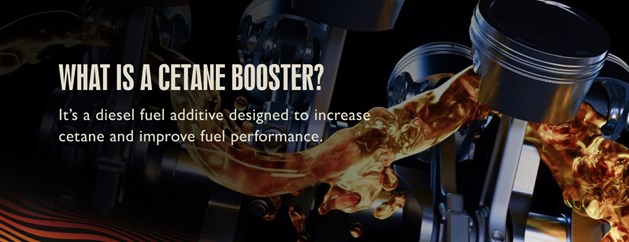
A cetane booster, also called a cetane improver, is a diesel fuel additive formulated to increase the fuel’s measured cetane number.
Depending on the formulation and treatment rate, adding a cetane improver can shorten ignition delay and change how quickly combustion begins.
So, in the most literal sense, cetane boosters do work. A properly formulated cetane booster can raise the cetane number of diesel fuel.
The more important question is whether your engine actually needs it.
When starting with diesel fuel that has inadequate ignition quality, increasing its cetane number may provide benefits such as:
How much difference you'll notice depends heavily on the fuel you started with, the engine burning it, and the conditions in which the engine is operating.
If you’re correcting genuinely poor-quality or low-cetane fuel, the difference may be noticeable. If your fuel already provides the ignition quality your engine is designed for, increasing the cetane number further may offer diminishing returns.
There isn’t one cetane number that is ideal for every diesel engine.
The appropriate cetane level depends on the fuel specification, engine design, operating conditions, and manufacturer requirements. Rather than assuming the highest possible cetane number is always best, diesel owners should make sure they’re using fuel that meets the specifications required for their engine.
If you’re unsure what your diesel requires, check your owner’s manual or the engine manufacturer’s fuel recommendations before adding a cetane improver.
Once diesel fuel provides the ignition quality an engine is designed for, increasing the cetane number further doesn’t necessarily produce proportional improvements in performance.
Not necessarily.
This is one of the biggest misconceptions surrounding cetane.
A higher cetane number does not automatically mean the fuel contains more energy or will produce more horsepower. Cetane primarily describes ignition quality, not the fuel’s energy content.
If poor ignition quality is preventing an engine from operating as designed, improving that fuel may help restore normal performance. But that is different from treating a cetane booster as a universal power additive.
Modern diesel engines use sophisticated electronic controls, high-pressure fuel systems, precise injection timing, turbocharging, and multiple injection events to control combustion. Once the fuel provides suitable ignition characteristics, simply increasing its cetane number further does not guarantee additional power.
It can, under the right circumstances, but don’t assume that a higher cetane number will automatically result in better MPG.
Improving poor ignition quality can contribute to more controlled combustion. But diesel fuel economy is affected by far more than cetane number.
Fuel economy can also be influenced by:
That’s why looking at diesel performance solely through the lens of cetane can be misleading.
If your goal is to get better MPG in a diesel truck, maintaining clean injectors and a healthy fuel system is more important than the ignition quality of the fuel itself.
No.
This is where the “more is better” approach to diesel additives breaks down.
Diesel engines are engineered to operate with fuel that meets particular specifications. Once you have fuel with appropriate ignition quality, continuing to increase the cetane number doesn’t necessarily provide proportional improvements in power, fuel economy, or engine protection.
Think of cetane as one fuel specification that needs to be right, rather than a performance score you’re always trying to maximize.
More importantly, cetane tells you about ignition quality. It doesn’t tell you everything about the overall condition of the fuel.
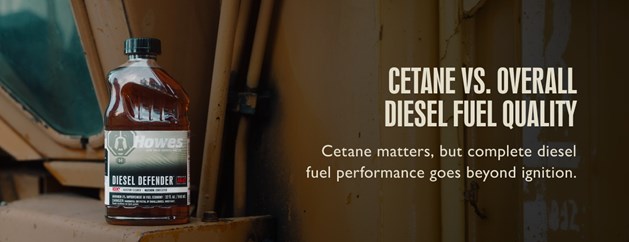
Cetane gets plenty of attention because it’s an easy number to compare. But good diesel fuel needs to do more than ignite at the right time.
Lubricity is another important consideration, particularly with today’s Ultra Low Sulfur Diesel (ULSD). Adequate lubricity helps protect fuel pumps, injectors, and other precision components from wear.
Injector deposits are another concern. Deposits can interfere with an injector’s carefully engineered spray pattern, contributing to inefficient combustion, increased soot, reduced performance, and wasted fuel. Understanding how diesel injector cleaners work can help diesel owners address another important part of the combustion process beyond cetane alone.
Water contamination can also create problems ranging from corrosion to microbial growth in fuel storage systems. Howes takes a demulsifying approach to water, separating it from diesel fuel so it can be captured and removed by the vehicle’s fuel-water separator rather than emulsifying the water and carrying it through the fuel system. Learn more about water in diesel fuel and how it can damage a fuel system.
In other words, you could have diesel with an excellent cetane number and still have fuel-system problems.
Cetane number tells you something important about your diesel fuel. It doesn’t tell you everything.
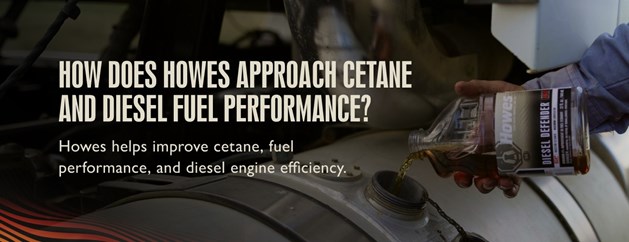
Howes takes a broader approach to diesel fuel performance.
Rather than making traditional cetane boosting the centerpiece of its diesel treatments, Howes products are formulated to improve combustion quality while addressing other important factors that can affect fuel-system health and performance.
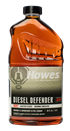
For warm-weather and year-round preventive maintenance, Howes Diesel Defender is designed to:
The idea is simple: instead of focusing on a single fuel specification, address multiple conditions that help the entire fuel system perform properly.
Clean injectors help maintain the precise spray pattern your engine was designed around. Proper lubricity helps protect high-pressure fuel-system components from wear. Separating water from diesel fuel helps keep unwanted moisture from traveling through the fuel system.
Those factors can affect diesel performance regardless of the fuel’s cetane number.
A cetane booster can make sense if you know you’re dealing with low-cetane fuel, your engine manufacturer recommends a particular cetane level, or you’re trying to correct a specific ignition-quality issue.
But if your goal is simply to protect your diesel engine, maintain performance, and get more from every gallon, don’t assume the additive advertising the largest cetane increase is automatically the best choice.
Look at the complete formula and what it actually does for your fuel.
Does it clean injectors? Does it improve lubricity? How does it address water? Is it safe for your engine and emissions system? Does the manufacturer provide testing to support its performance claims?
Those questions can tell you considerably more about an additive’s overall value than cetane boost alone.
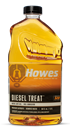
Your fuel-treatment priorities can also change with the seasons. When temperatures start dropping, for example, understanding how to keep diesel fuel from gelling becomes critical. Howes Diesel Treat is formulated for cold-weather diesel protection, including preventing fuel gelling while improving lubricity and helping manage water.
Yes. A properly formulated cetane booster can increase the cetane number of diesel fuel.
Where diesel owners should be more skeptical is the assumption that a higher cetane number automatically means more horsepower, significantly better fuel economy, or better overall engine protection.
Cetane is one part of diesel fuel quality.
For most diesel owners, the better goal isn’t to make one number as high as possible. It’s to make sure the fuel provides what the engine needs while keeping the entire fuel system clean, lubricated, protected from water, and operating efficiently.
That’s the broader philosophy behind Howes diesel fuel additives. Rather than focusing on cetane alone, Howes products address multiple real-world problems that affect diesel fuel and fuel systems throughout the year.
Better diesel performance isn’t about chasing one number. It’s about taking care of the fuel and the entire fuel system.